
The Magic of Curiosity and Mess: How Montessori Unlocks Children’s Cognitive Potential
Curiosity and a willingness to get messy are not just endearing childhood traits; they are essential drivers of cognitive development and are deeply embedded in the Montessori method of education. Understanding why these qualities matter helps parents and educators create environments where children thrive as creative, resilient, and lifelong learners.
The Power of Curiosity in Childhood
Curiosity is the innate urge to explore, ask questions, and seek answers. It is described as the “wick in the candle of learning,” sparking a child’s desire to try new things and discover how the world works. When children are encouraged to follow their interests, they develop confidence, resilience, and a passion for learning that lasts a lifetime. This drive to understand not only makes learning exciting but also builds the foundation for critical thinking, problem-solving, and adaptability.
Messy Play: A Gateway to Discovery
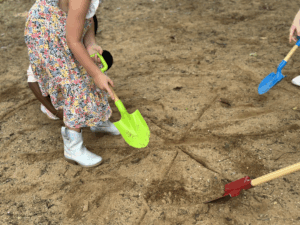
Allowing children to engage in messy play—whether it’s squishing mud, mixing colors, or experimenting with household items; provides more than sensory delight. These experiences help children understand cause and effect, develop fine motor skills, and foster a deeper curiosity about their environment. Each “messy” experiment is a hands-on lesson in science, creativity, and perseverance, teaching children to make predictions, test ideas, and learn from outcomes, even when things don’t go as planned
“Each messy experiment helps children understand cause and effect, builds fine motor skills, and deepens their curiosity. By letting them freely explore, we’re giving them the gift of curiosity that will stay with them for years to come.”
Montessori and the Nurturing of Curiosity
The Montessori method is uniquely structured to cultivate curiosity and embrace the productive chaos of learning. In Montessori classrooms, children are given the freedom to choose their activities, explore at their own pace, and pursue projects that genuinely interest them. The environment is intentionally designed with hands-on materials that invite exploration and experimentation, making learning an active, sensory-rich process.
Montessori educators, often called “guides,” play a crucial role by observing each child’s interests and providing gentle support rather than direct instruction. They encourage questions, allow time for reflection, and foster a safe space for children to make mistakes and learn from them. This approach not only nurtures curiosity but also builds independence, confidence, and a lifelong love of learning.
Cognitive Development: The Lasting Impact
Curiosity and messy exploration are directly linked to cognitive growth. When children are free to wonder, experiment, and get their hands dirty, they develop:
-
Critical thinking skills: By asking questions and seeking answers, children learn to analyze, synthesize, and evaluate information.
-
Creativity and imagination: Open-ended play and discovery foster original thinking and innovation.
-
Resilience and a growth mindset: Curiosity helps children embrace challenges, learn from setbacks, and persist in the face of obstacles.
-
Emotional regulation: Studies show curious children are more emotionally balanced and less anxious as they grow.
Conclusion
Encouraging children to be curious and messy is not about tolerating chaos for its own sake; it is about recognizing that exploration and experimentation are the engines of learning. The Montessori method exemplifies this philosophy, creating environments where curiosity is celebrated, messes are seen as opportunities, and each child’s unique path to understanding is honored. By nurturing these qualities, we empower children to become confident, creative, and capable thinkers, ready to navigate and shape an ever-changing world.
References:
-
Lillard, A. S. (2017). Montessori: The Science Behind the Genius (3rd ed.). Oxford University Press.
-
Engel, S. (2015). The Hungry Mind: The Origins of Curiosity in Childhood. Harvard University Press.
-
Ginsburg, K. R. (2007). The Importance of Play in Promoting Healthy Child Development and Maintaining Strong Parent-Child Bonds. Pediatrics, 119(1), 182-191.
-
Whitebread, D., et al. (2012). The Importance of Play: A Report on the Value of Children’s Play with a Series of Policy Recommendations. Toy Industries of Europe.
-
Montessori, M. (1967). The Absorbent Mind. Holt, Rinehart, and Winston.
-
Bonawitz, E., et al. (2011). The Double-Edged Sword of Pedagogy: Instruction Limits Spontaneous Exploration and Discovery. Cognition, 120(3), 322-330.
-
Center on the Developing Child at Harvard University. (2016). From Best Practices to Breakthrough Impacts.
-
Fisher, K. R., et al. (2013). The Role of Play in Supporting Children’s Development. Early Childhood Research Quarterly, 28(2), 223-234